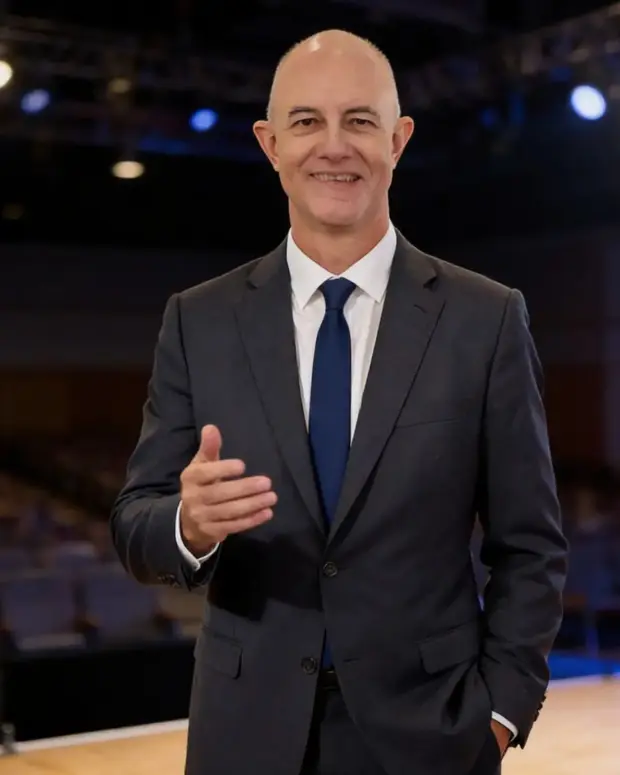
Transcript from the episode recording, with speaker names added and paragraphs formatted for readability. Automated transcription may contain errors; the audio is the original record.
Brad Hauck 00:14
Ever find yourself wondering if you should go all in on your local market or take your message to the world? It's a big question for any speaker. Today we're talking about the real arguments for going global versus staying local. What works, what doesn't, and how to figure out which path actually fits with your goals and your lifestyle. Good morning, Dixie.
Dixie Carlton 00:33
Good morning, Brad. How are you going today?
Brad Hauck 00:36
Going very good, thank you.
Dixie Carlton 00:38
I hear you're getting yourself a new car, which sounds exciting. Great start for the week.
Brad Hauck 00:43
Looking forward to that. So always exciting to have change.
Dixie Carlton 00:47
Yes.
Brad Hauck 00:48
Especially new toys. We all like new toys.
Dixie Carlton 00:51
And we were just talking the difference between investing in new cars versus travel. For me, I prefer to travel and go broader afield. You prefer to have a really cool car and be more locally focused and metaphorically and literally. And I think that leads us really well into what we're going to talk about today. So tell us.
Brad Hauck 01:10
Look, you know, everybody looks at their budget differently. And I've always leased cars through my company, so I do write off a large chunk of it, which is handy. But getting that balance right, you can lease a car for $2,000 a month, or you can lease one for $500 a month and leaves you free $1,500 to travel. So you've got to find that balance, don't you?
Dixie Carlton 01:27
Got to find that balance. And balance is what we're going to talk about today in terms of going global versus staying local.
Brad Hauck 01:35
Exactly. So there's lots of arguments for and against. So we're going to run through some for's going global and some against. And the first one that I've got on my list here is that when you go global, you have an expanded audience and an expanded impact.
Dixie Carlton 01:50
You do have a much more expanded impact. You can be talking to people from as far away as the opposite side of the world, completely different cultures. It does somewhat depend on what your particular topic is and whether it's something that you want to do, but it takes a lot of planning to decide to go to that further reach. Where have you like you're in technology? How do you manage this decision making?
Brad Hauck 02:18
Quite enjoy going international. Obviously, you can go international from home, like on YouTube, which is something I like to do. But then also going to countries that you haven't been before can be really exciting. So, for example, I really love going to Singapore and speaking over there because it's such a mash of cultures and they're so business orientated. This is very empowering, but it also gives back a lot of energy because they're very enthusiastic audiences and they're keen to learn. So it can be a very powerful experience for you as a speaker, as well as for the audience.
It can change your life going overseas.
Dixie Carlton 02:54
It's one of those things. If you are an international speaker, you've got amazingly advanced credibility, authority back in your own country. When you say, look, I have been speaking in lands far away, people locally immediately assume somehow that you've got more credibility or you've increased your authority. So it can definitely boost that perception. But being seen on global stages obviously adds to your status as a thought leader. And you can therefore create a lot more demand for your expertise. The fees structure is something that we'll get into a little bit further into this conversation, but there is a huge difference in what you have to invest in in terms of being able to be seen internationally versus locally.
Brad Hauck 03:41
Yeah, there is. And it really depends on how you run your business. As I said, we have all different sorts of speakers listening to us. We've got speakers who speak for free and make their money out of their business. We've got speakers who speak for money and don't necessarily run a business. They are speakers only. And I think the opportunities are there and they can be really mixed. For example, going to speak in a country that you haven't been in before, and maybe you're paying your own way in speaking, there's other benefits. You've got the social media benefits, you've got the content benefits, you've got the credibility of being seen on a stage somewhere else in the world when you put it up.
People see those sorts of things. On the other hand, if you're getting paid to fly there, can be very high rates. Yeah. There's a whole lot of stuff going on.
Dixie Carlton 04:24
Speakers with international experience will often command a much higher fee, even for local, especially with corporate or government. Conference organisers just perceive that it's a standard thing to pay more for a global speaker. So you have to balance that as well. If you're wanting to become a fully fledged international speaker, you have to get that experience to then drive that machine forward. And so you have to, it's almost like which comes first, the chicken or the egg. And sometimes an easier way around that is to actually go with one of these options where you are paying to go, whether it's something like your own industry association and you want to be seen on an international stage so that you can put the badge of, yes, I have spoken in X number of countries, or some speakers will say that they've spoken on X number of continents or whatever.
And I'm guilty of doing that. It was much easier to say that it's broken on three governments than say that really we'd only actually spoken on five different countries at the time. But there are ways around getting those opportunities for the big paying ones. And sometimes that comes down to investing in yourself to get on an international stage where it is either a pay-to-play or it is an association or an industry specialist thing that you are devoting yourself to and calling it professional development.
Brad Hauck 05:44
Exactly. And look, this isn't faking tear making. A lot of people tend to see it that way as oh, you paid to be on that stage or you became a sponsor of that event so that you could speak. No, that's business. That's called marketing for people who are thinking that way. Marketing is very important. Doesn't matter whether you're speaking or selling products or doing services for people. Being on a stage is part of marketing. In fact, that's how I built my SEO company was specifically by speaking. Speaking was my advertising. It was a chance to give back to the audience to teach them things, and then they come to me for help when they needed advanced help.
There's nothing wrong with that. It's not faking to your making.
Dixie Carlton 06:24
No, it's not. And I I've just been invited to speak in Rome and Paris, which both sound fabulous as a keynote speaker. And last year, or sorry, earlier this year, I was also invited to speak in Miami. And I thought, wow, that's really cool. And I turned that down and opted to do the virtual option instead. But before I had even turned it hip on, the organizers had actually created a banner for me, which said that I was a keynote speaker at an event in Florida. And I thought, whoa, that's a quick screenshot. I haven't used it out of integrity to promote myself, but I grabbed it as a means of saying, yes, hey, put it out there.
I want more international speaking. So it's served as a as an incentive for me to remind myself to go for that because that's something that I'll really want to focus on for next year. But these two opportunities to speak in Rome and Paris are in fact, I have to pay to be on stage. It's a very nominal fee of 400 euro. But the value that I'll get out of that is significantly more than that investment. And it is a big conference, it is a well-respected conference, it's going to have really good people there, it's being well run.
So all of those things you have to actually look at and say, do I want to get on a plane and go all the way over to the other side of the world and do that? And maybe as a part of this, I can leverage that opportunity to get another couple of paid gigs over there anyway. So sometimes you've got to look at if you're going further afield, and if some of it you're having to pay for, but that puts you into a market where you want to do more that you're going to be paid for, then you've got to think of that as a big whole project that you've got to wrap everything else around and really consider it thoroughly.
Don't just overlook the concept of, I normally get paid to speak on stage. So, you know, if I have to pay to be there, that's not a good thing. Sometimes you've got to look past that, especially if you are developing your whole thing around being an international or a global speaker.
Brad Hauck 08:30
Yeah, and once you're overseas, so obviously Australia, we're really isolated and everywhere we go is a long way. So once you get overseas, then the opportunity is to do other things while you're there. So you do a speaking engagement, you can have a short holiday, or you can catch up with some business contacts, or you might jump to another speaking engagement. For example, spoke in Bali, and then there was an opportunity to do a showcase in Singapore. Now, I didn't know whether that showcase was going to lead to any work, but it was only a two-hour flight.
So why not jump on a two-hour flight and go there? If I was to go from Australia, we're talking eight hours. Because it was in Bali, it was a quick jump. And so sometimes one opportunity when you are speaking overseas can put you in the position to jump on another one just because you happen to be close, a bit like you with France and Rome, or Paris and Rome, shall I say? And you've got to look at how you can leverage those opportunities as well while you're there.
Dixie Carlton 09:25
And let's not overlook the fact that a tax-deductible trip to my two favorite cities in Europe, that's not a hard decision, right?
Brad Hauck 09:34
Yeah, and that's a big one. I think a lot of people miss this. One of the advantages of being in business and having a business registered is that you can claim things on tax. So if you go to Rome to speak and you're paying, that is a business trip. Okay. It might be advertising, but it is a business trip, which means you can claim your flights, your parking, your accommodation, a certain amount per day for food, all those things while you're there on business. Yes, you could add five weeks of holiday afterwards, but it's not business, you can't claim that.
But every speaker learns very quickly, I think, that when you go places to speak, you should always add a little bit of extra time to get to see the city or something like that. Unless you're flat chat, of course.
Dixie Carlton 10:18
Exactly. Practicing my tremiet and means that that's a whole thing of discussing different cultures and languages and event styles, which really forces you to grow professionally and personally. I haven't actually accepted this opportunity yet, I have to say, but I probably will. Because everything points towards it being a good idea from a bigger ecosystem marketing perspective. But it also means that professionally and personally, it helps me to get out of my normal zone when I'm speaking and writing. It also means that I am also going to have a look at sharpening my message and my delivery, my communication skills in a foreign language, learning to use translation services.
All of RAUS things are very big learning curves. But wow, once you've started to get your head into that's a really good learning curve that pays.
Brad Hauck 11:13
Yeah, absolutely. No, look, there's a lot to be learned going overseas. Just even seeing how different people do things and going to the different cultures, trying the different languages and the different event styles, there's a lot to be seen from that. For example, you know, some of the speakers I know who work in Asia, the rooms are vastly different. Maybe over here we might be doing mainly mixed business audiences. Over there, it's all executive staff and they're all in their suits and they're all dressed a certain way, and there's protocols and all that. And it's a huge learning experience.
And if you go to places in the Middle East, it's different again. You go to London, it's different again. And so every time you go somewhere, you're being exposed to different cultures, you're learning about them, which for me is really interesting. But also that old thing about a piece of elastic once stretched never returns to its original shape. It can change you forever. I've seen so many people who have not really been overseas and gone overseas, and when they come back, they are a different person. Because they've seen a different world. In your country day-to-day might be great and you might have a great business, but until you see the world, you start to realize that it is an amazing place.
And speaking can give you the opportunity to be paid to see it.
Dixie Carlton 12:27
Absolutely. And the relationships that you build, the partnerships, the cross-border business modeling, having the opportunity to diversify your brand through that multilingual content can be an extraordinary thing for a speaker. Not to the long-term legacy. You know, if you're a speaker who goes global, you really do have a much greater potential for leaving a lasting legacy. Global education, influence, published works, all of those things take on a much bigger meaning when you are looking at things from a global perspective.
Brad Hauck 13:01
Yeah, absolutely. And I think from my perspective, you're trying to help people change their lives. And how you do that depends on your content. But if you're just holding yourself back in your country and you never travel overseas and share that with people, it's such a shame because you could change so many lives. And you don't know what your message might take off in another country far better than it's ever taken off in your own country. It might just click and go because of the cultural difference. You know, it's if we compare to the culture in the USA compared to Australia, we have tall poppy syndrome here.
You don't stick up your head or you'll get it chopped off. Whereas over there, self-promotion is an accepted thing. And look how good I am is normal. Over here, that will get you shunned. So just changing where you're doing things can often change your life in many ways.
Dixie Carlton 13:54
Absolutely. And that brings us to a really good point. Let's talk about the arguments against going global, because sometimes local might be better. There are the costs and complexities. Obviously, you've got higher travel costs that you have to accommodate in your budget every year. You've got logistical issues, and what happens if you are traveling over one side of the world and that clashes with something that you're doing locally, whether it's a family matter or a business matter, or even another speaking engagement, and you have delays in flying, or you're exhausted and you're going from one stage to the next stage across countries and you're dealing with different time frames and zones, you've got visa issues.
Brad Hauck 14:36
Okay, okay. Hang on, you get carried away. There's too much there, you're going to scare the audience.
Dixie Carlton 14:42
Okay, all right.
Brad Hauck 14:50
But they don't always happen. Sometimes everything just goes normally. In fact, most times everything goes normally. Other times, yes, you do have problems. But if you are prepared up front, so for example, visa issues, that's something should be taken care of months in advance because some countries do have complicated visa systems, for example, the USA. Whereas other countries like Singapore, you fill in a form online, you turn up, and you're pretty well right, as long as you've been honest. So there's vast differences. But look, traveling overseas is hard work at first until you start to understand little things.
For example, switching airlines can lead to lost luggage, but staying with the same airline often takes care of that. Or using a travel agent to book your travel rather than you doing it yourself. So if there's a problem, they can sort it out for you. That's one thing I do when I do long distance travel. I have friends that are in travel agency and I let them do the travel. If I'm flying just one way here to Singapore and back or here to Bali and back, I'll just do that myself. It's breaking it down into steps so that it doesn't overload you.
So there's a lot of cost and complexity, but in essence, you've got you've got your flights, you've got your accommodation, you've got parking. Transfers is the one that freaks me out. I hate transfers because I'm afraid I'm going to be stuck at the airport, which is just stupid because there's always a bus leaving an airport somewhere. But that's where I kind of stress. The good thing to do, I recommend, is to go and talk to another speaker who travels a lot and say to them, how do you do it? What's the best way to do this?
Have you been to this country? And if they haven't, say, Do you know someone who's been there? And just get some tips from someone who's been there once or twice because they will know. It's like going to Japan, but you can get the airport bus. Now, the airport bus has heaps of leg room. I didn't know that, but I can tell you that now. My legs can fit in, which is saying a lot because I'm 6'4. And so just knowing that because I've been there will make your life so much easier as a speaker going there for the first time.
Dixie Carlton 16:55
That is absolutely true. And networking with other global speakers means that you also pick up on all kinds of tips. Everyone's got something to share. And I think while it can be frightening, there are so many good reasons to not let the fear hold you back. But then sometimes you need to think about things like there there being a cultural misalignment. Maybe your message is specifically focused and best focused on local market. For example, if you work in education, it may be that you know your message is going to hit fall better with teachers on a local basis than it is with teachers in other countries.
It just depends entirely on your message. Messages that resonate locally can completely fall flat or even sometimes offend in other cultures.
Brad Hauck 17:45
That's a big one. Yeah, offend is an issue. For example, if you're a motivational speaker, you might have a style that in your country is, yeah, everyone's powered up. And you go to another country and they're like, oh, what did you just say? Yeah. You really do have to do your research about that alignment and look at what other people who are speaking there are doing and how they're doing it.
Dixie Carlton 18:06
You do. And the other thing that you can need to think about before you embark on an international strategy with your career is whether or not there's a diluted focus. Because trying to go global too soon can actually weaken your brand's clarity. It's often a lot better to be a hero and well known in your own backyard or dominate your niche locally before attempting that global expansion. Be someone that everybody's talking about in your own backyard, get all of those testimonials, really refine and hone your message, make sure you are ready to do international and then branch out into that.
But again, you need to do it strategically, I think.
Brad Hauck 18:48
Yeah. But sometimes you never know where the opportunity is going to come. When I first started speaking, I've done five or ten gigs here in Australia. And then I got a call from an agency that said, Oh, would you like to speak in Wellington in New Zealand? And I was like, Yes, if you're going to pay me. And it was a great opportunity. I went over there and I spoke at a conference. I had a great time. And I ended up speaking for the same organization about two years later at a conference in Australia. It was a really great opportunity.
Now I would have never found that. It was just one that was thrown in my direction and it fit with my content and my topic and the right market. So sometimes you'll get the random ones thrown in that don't hurt you, but you're right. You can concentrate a lot of time and effort and money. I've talked to people who, for example, moved to America to work, and they spent 10 years, as I put it, in the wilderness, basically trying to build their brand. Now, some of them succeeded, and some of them just never got traction.
And yet they gave up everything that they had here to go over there to chase their dream, which is a good choice if that's what you want to do.
Dixie Carlton 19:53
Yeah. And if the money's there, and if the credibility and the fulfillment of your own aspirations is there, then yes, you've got to grab every single opportunity to do that. But it is not just a matter of deciding and everything falls into place. Again, coming back to what I'm always talking about, you need to have a good strategy. You need to plan it in most instances, apart from those odd times where something just drops into your lap, as you said. You need to be thinking about it from a long-term point of view. You can't just dip and dive into being international.
If you're going to be an international presenter or an author, you need to be thinking about it and how it's going to be impacting on your whole marketing ecosystem.
Brad Hauck 20:36
Yeah. And, you know, the old story too, when you travel overseas, you're spending money, often there might not be the return that you expected. And that's a big one. You think you're going to go to a country, you're going to be eaten up, all the big conferences are there. So, you know, one will lead to another and doesn't go anywhere. We've all had that happen. I've certainly had it happen, where you think that this opportunity is going to open all these doors. And in fact, it wasn't an opportunity at all. And it didn't even open the single door where you were.
And that can be quite sad, to be honest. You put a lot of effort in, you travel, you do the gig, do your best, and you seem to get on with the audience, and everybody just comes up afterwards. Oh, you were fantastic. Thank you so much. Really enjoyed it. Sometimes that's a cultural thing. It's just like they always say those things. That's something to know. And then you walk away and you don't hear Jack from anybody ever again. And that's a kick in the pants sometimes.
Dixie Carlton 21:34
Yes, absolutely. Nothing so humbling as the silence that follows success.
Brad Hauck 21:41
Yeah, yeah, you think you've done well. You come on stage and you're like, I feel good. Oh, thank you. Crickets.
Dixie Carlton 21:48
So with that to summarize, I think there is always value in extending yourself internationally. If you can make it work for yourself, that's fantastic. But if it's something that really doesn't fit, and I've got speaker friends who have traveled extensively for years, and actually as a result of COVID or travel fatigue, they've just decided, nope, I'm now going to do everything either remotely via digital or I'm just going to only work in my own country.
Unidentified speaker 22:18
Yeah.
Dixie Carlton 22:18
Yeah.
Brad Hauck 22:20
And plenty of speakers, especially experienced speakers, tell me that they'll be happier if they never get on the plane again. Because they've flown so much. Now, when I was told that, I was the news speaker, and I'm like, yeah, right. I get that. You're away from family, you're away from friends, you're away from all the other stuff that you do. I find when I'm away, I don't get any work done. I get a bit of planning and stuff done, but I don't get any serious work done because I'm I go into holiday mode. It's that simple.
So you know, it can affect your business flow. If you're away every week, you'll find you come back and you've got to try and get back in the swing of things. Now, some people can just turn it on and turn it off. Yeah. Personally, I just can't. And so it makes you think about your business structure, even. If you're running a business where you've got service and you're doing the service delivery, well, if you're going to be the speaker and you're traveling a lot, maybe you need staff to do the service delivery. So you can just concentrate on speaking and getting clients, and then they can deal with the clients.
You may need to even restructure your whole business if you go down this route.
Dixie Carlton 23:24
You may. And again, it comes back to some planning.
Brad Hauck 23:29
Not much.
Dixie Carlton 23:30
No co-planning.
Brad Hauck 23:31
Every time you wake up, it's a new day, we'll see what happens.
Dixie Carlton 23:35
You'd be surprised how often I do fly by the seat of my pants. But at the same time, I think it's something that you can't just decide one morning you're going to do this and then just make it happen the next day. It does take a bit of time to brand and develop, to take those opportunities and to really develop what where you want to be speaking, where you want to be writing. This is everything we've just talked about is also true for authors. Sometimes you've really got to think about is my book going to be amazing in Australia, but completely not fit America?
Or is it going to be a much better fit in America or the UK than what it is in Australia?
Brad Hauck 24:13
So yeah, absolutely.
Dixie Carlton 24:15
Yeah. There's a whole world out there.
Brad Hauck 24:18
Oh yeah. Look, I think my approach has always been, I'll chase the opportunities where I think I fit with the audience. If it doesn't work out, I always have a couple of days wherever I go. So I've had a holiday and I've seen somewhere I haven't seen before. So the payoff for me is the fact that I'm actually seeing the world and getting paid to do it.
Dixie Carlton 24:38
Yes. And on that note.
Brad Hauck 24:39
And if nothing else, I've had a great time.
Dixie Carlton 24:42
And on that note, I think we should bring this to an end because I'm all excited about booking my next trip.
Brad Hauck 24:48
Absolutely. So thanks for tuning in to the experts' journey. If you picked up some useful tips today, take a moment to subscribe and share this episode with a fellow speaker or expert or author in your network. It really helps us reach more people and help them succeed. And don't forget to check out our books on Amazon. Start with the draft, how to easily plan and write a nonfiction book, An Authority Island. And my book, Microcourse Profits, How to Build Income Streams and Authority with Micro Learning Courses. Both are packed with practical tools to help you grow your business faster.
We'll catch you next time.
Dixie Carlton 25:20
Thanks, Brad.